22. Designing a vertical plant: criteria and logic
Designing a vertical farming system does not mean "stacking crop plans." It means orchestrating lighting, water, air, nutrients, space and automation in a closed system that maximizes yield, production consistency and operating costs.
It is a balance of agronomy, engineering, and industrial logic.
Index
-
Why design is crucial
-
The 5 initial structural decisions
-
The technical parameters to be defined
-
Lighting: how to size it correctly
-
Microclimate and airflow
-
Nutrients, water and sensors
-
Software, AI, and automation
-
Mistakes to avoid in design
-
Tomato+ case: integrating hardware, data and AI
-
Conclusions
1. Why design is crucial
A vertical plant is not simply an extension of a traditional hydroponic system.
It is an industrial production system where:
-
every error is multiplied by the number of levels, plants and cycles
-
every recurring inefficiency becomes OPEX
-
every variability ruins crop predictability
That is why design is not a phase to be improvised: it is the most important part of the project.
2. The 5 initial structural decisions
Every vertical plant is born from five fundamental choices:
(a) Production objective.
-
Leaves?
-
Microgreens?
-
Basil and aromatics?
-
Baby leaf?
-
Research and experimentation?
Each product requires different EPPs, DLIs, and cycles, so the structure of the plant also changes.
(b) Available space (volume, not just area).
They count:
-
usable height
-
lateral accessibility
-
safety distance from walls
-
presence of doors, pillars, existing facilities
(c) Number of levels
More levels = more output, but also:
-
more heat dissipation
-
more fresh air consumption
-
more uniformity that is difficult to maintain
(d) Level of automation
Manual, semi-automatic, AI-driven.
(e) Business model
-
direct sales?
-
horeca?
-
LARGE-SCALE RETAIL?
-
university research?
-
corporate farming?
Each model changes CAPEX, OPEX and ROI.
3. The engineering parameters to be defined
Here are the engineering parameters that determine the quality of the plant:
- DLI (Daily Light Integral).
Used to calculate how much light each plant should receive based on variety.
- PPFD (µmol/m²/s) per level.
Essential value for calibrating power and density of LEDs.
- Thermal load of the plant.
More light = more heat = more need for air conditioning.
- Air volume required
Calculated to ensure:
-
CO₂ sufficient
-
stable temperature
-
humidity within range
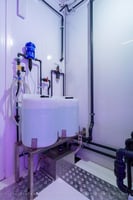
- Water flow rate, tank volume and recirculation.
Stability of the nutrient solution is critical.
- Rack layout
It all stems from:
-
aisle length
-
man access
-
ergonomics
-
operational management
4. Lighting: how to size it correctly
Lighting is the heart of vertical farming: it is worth up to 50% of CAPEX and up to 70% of OPEX (energy).
To design well, one must consider:
1) Light spectrum.
Advanced systems use 6 independent channels (such as Tomato+) to stimulate growth, color, compactness and yield.
2) Uniformity by level.
Poor uniformity implies:
-
uneven growth
-
uneven yields
-
wasted energy
3) Active Cooling
With liquid-cooled LEDs (such as Tomato+ technology) it is possible to:
-
reduce power consumption by 50%
-
increase light density
-
minimize thermal stress on plants
4) LED-plant distance.
Critical parameter to avoid photoinhibition.
5. Microclimate and airflow.
Airflow must:
-
evenly distribute temperature and humidity
-
avoid dead zones
-
prevent condensation (and thus fungus)
-
support leaf transpiration
Key elements:
-
CO₂ between 600 and 1200 ppm
-
VPD optimized (0.8-1.2 kPa per leaf)
-
controlled air changes
-
laminar or semi-laminar flows
A vertical system works only if each level lives under the same conditions.
6. Nutrients, water and sensors
Fundamentals:
-
Stable EC and pH
-
reliable sensors (H2/H4 → safety EC; HPro → full EC+pH)
-
constant circulation and oxygenation
-
sized tanks
-
Proper Nutrient Film Thickness
Water is the "blood" of the system: if it is unstable, the whole system fails.
7. Software, AI and automation
A modern vertical plant does not work without:
-
real-time monitoring
-
AI-driven image collection
-
comprehensive telemetry
-
scalable cloud systems
-
Dynamic growth plans
The Tomato+ model uses an AI pipeline that:
-
collects images by plan
-
analyzes real parameters
-
automatically corrects cycles
-
optimizes yield and quality
It is the natural evolution of vertical farming:
not just hardware, but software that grows.
8. Mistakes to avoid in design
Most common ones:
❌ Overestimating the usable height
❌ Putting too many levels without considering thermal dissipation
❌ Uneven lighting
❌ Non-ergonomic layout
❌ Lack of airflow between floors
❌ Undersized nutrient solution
❌ Insufficient automation
❌ No redundancy plan
9. Tomato+ case: integrating hardware, data and AI
Tomato+ structured the entire home and professional vertical system with:
✔ 6-channel LED with independent control
✔ Camera and AI for leaf recognition and diagnostics
✔ Scalable AWS cloud software
✔ Advanced sensors on HPro
✔ AI-based dynamic growth plans.
This enables:
-
zero soil
-
zero pesticides
-
extremely low water consumption
-
total control
-
constant productivity
-
replicability in any environment
10. Conclusions
A well-designed vertical plant is not a light rack, but an industrial system in which every parameter is orchestrated.
Those who design it correctly achieve:
-
extremely high yields
-
predictability of cycles
-
consistent quality
-
costs under control
-
scalability
Those who get the design wrong ... multiply the errors for every level, every plant, and every cycle of the year.
Thank you for reading this article. Keep following us to discover new content on hydroponics, vertical farming, and smart agriculture.
Tomato+ Team