23. Multi-layer lighting: how to optimize it
Introduction
In vertical farming, lighting is one of the most crucial determinants of energy cost, yield and crop quality. In multi-layer systems - structures with multiple overlapping layers - optimizing light means ensuring uniformity, efficiency and repeatable production cycles.
A well-designed multi-layer system leads to:
-
more yield per square meter,
-
greater control over growth,
-
lower consumption,
-
consistent quality 365 days a year.
What is multi-layer lighting
In a vertical system, each shelf needs a dedicated set of lights. The challenge is to maintain sufficient and uniform intensity despite the minimal distance between LEDs and canopy.
The goal: to create micro-environments of identical light on each tier.
Key advantages
-
Denser productions in the same space
-
Reduction of light wastage
-
Total control of spectrum and intensity
-
Standardization of cycles
-
Production scalability
Key parameters to manage
1. PPFD (photon density) -range of your first version.
For high performance in vertical farming, the most common reference ranges are:
-
Baby leaf and salads: 120-250 μmol/m²/s
-
Herbs: 200-350 μmol/m²/s
-
Microgreens: 80-200 μmol/m²/s
PPFD should be uniform between planes, avoiding differences that cause uneven growth.
2. Light uniformity
In multi-layer systems, the LED-plant distance is only 15-35 cm. Therefore, lighting designed to:
-
avoid hotspots,
-
cover the entire surface of the shelf,
-
distribute light symmetrically.
3. Full light spectrum
An effective spectrum for multi-layer cultivation includes all bands critical for plant physiology:
-
Blue (450 nm): compact structure, stomatal regulation
-
Green (500-570 nm): penetration into the lower layers of the canopy
-
Yellow (570-590 nm): improved growth uniformity, controlled elongation support
-
Amber (590-620 nm): mild photosynthesis, stress reduction, improved color yield
-
Red (660 nm): productivity and biomass
-
Far-red (730 nm): morphological control and extensive growth
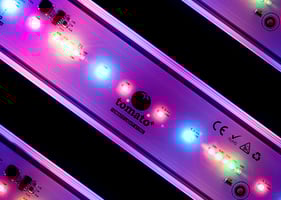
Tomato+ LEDs integrate 6 independent channels that enable precise modulation.
4. LED-chioma distance.
It should be kept constant.
Too close → photon stress.
Too much distance → energy waste.
Tomato+ greenhouses employ:
-
spectrometers,
-
AI chambers per floor,
-
light sensors,
to automatically correct intensity and spectrum.
5. Level design.
The distance between floors must ensure:
-
sufficient airflow,
-
accessibility,
-
heat dissipation,
-
space for maximum plant growth.
How to optimize a multi-layer plant
1. Use independent channel LEDs.
Tomato+ modules allow:
-
different spectrum for each layer,
-
optimization for different varieties,
-
accurate simulation of natural light.
2. Advanced cooling
Liquid cooling of LEDs-Tomato+ technology-reduces power consumption by up to 50%, maintaining constant efficiency and increasing system lifetime.
3. Intelligent software and AI
Lighting management must be dynamic:
-
PPFD adaptation by phase,
-
spectrum variation,
-
optimized photoperiod,
-
automatic corrections via camera + AI.
The Tomato+ system uses Dynamic Growth Plans powered by camera, telemetry and AI cloud.
4. Photoperiod
Generally between 14 and 18 hours of light, varying by variety and crop stage.
AI allows it to adjust in real time to avoid stress.
5. Continuous monitoring.
Chambers, spectrometers and sensors allow to:
-
detect abnormalities,
-
improve uniformity,
-
adapt light to physiological changes,
-
collect data for future optimizations.
Common errors
-
LEDs not designed for multi-layer
-
PPFD too low or not uniform
-
lack of control
-
levels too close together that create shadows
-
identical spectrum for all varieties
-
lack of automation → wasted energy
Conclusion
Multi-layer lighting is the key to making a vertical farming system scalable, efficient and highly productive.
By combining multi-channel LEDs, full spectrum (blue + green + yellow + amber + red + far-red), sensors and AI, high yield, consistent quality and low power consumption can be achieved.
Tomato+ technologies--proprietary LEDs, per-floor AI chambers, spectrometers and dynamic Growth Plan--maintain total and automatic control over every level of the greenhouse.
Thank you for reading this article. Keep following us to discover new content on hydroponics, vertical farming, and smart agriculture.
Tomato+ Team