34. How artificial intelligence works in indoor cultivation
In recent years, artificial intelligence has become one of the most frequently mentioned concepts in indoor agriculture. However, it is often reduced to a marketing term, without explaining what an AI system applied to cultivation actually does.
In this article we look at how artificial intelligence works in indoor cultivation, what data it uses, how it makes decisions, and why it represents a real evolution from traditional automation systems.
Automation and AI: a substantial difference
An initial clarification is essential:
-
Automation: executes predefined rules
-
Artificial intelligence: learns from data and adapts over time
An automated system reacts to fixed thresholds.
An AI system, on the other hand, observes the result of its actions, compares different cycles and progressively optimizes growth parameters.
In advanced indoor cultivation, AI becomes the top decision-making level.
Data as the foundation of artificial intelligence
AI does not work without structured and continuous data. In indoor cultivation systems, the main categories of data are:
Environmental data
-
temperature
-
humidity
-
CO₂
-
airflow
-
microclimate stability
Hydroponic data
-
pH
-
EC
-
temperature of nutrient solution
Growth data
-
growth rate
-
uniformity
-
biomass
-
harvest times
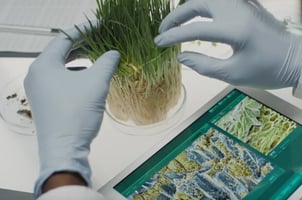
Visual data
-
periodic plant images
-
morphological analysis
-
early detection of stress
Light data
-
photoperiod
-
intensity
-
spectral composition
The value is not in the individual data, but in the correlation between these variables over time.
The role of light in AI-driven systems
Light is one of the most powerful levers in indoor growing, but also one of the most complex to manage.
In Tomato+ systems, lighting is based on 6 independent light frequencies that can be controlled separately. This allows different spectral combinations to be generated depending on:
-
the variety being grown
-
the growth stage
-
of the production goals
The key aspect is that these parameters are not static, but become an integral part of the AI model.
How AI makes operational decisions
The operation of artificial intelligence follows a cyclical process:
1. Continuous data collection.
Sensors, cameras, and lighting systems generate constant streams of information.
2. Analysis and pattern recognition
AI identifies relationships between environment, light, nutrients and plant response.
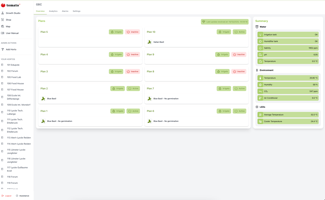
3. Growth Plan definition.
Patterns are translated into operational parameters:
-
light curves (including multi-frequency)
-
irrigation cycles
-
environmental targets
4. Feedback loops
Actual results are compared with expected results.
The system corrects parameters and improves cycle after cycle.
Why AI is particularly effective indoors
Indoor cultivation offers ideal conditions for artificial intelligence:
-
controllable variables
-
reproducible conditions
-
absence of climate noise
-
comparable data over time
In the open field, AI is limited by climate.
Indoors, it can reach its full potential.
Concrete benefits of artificial intelligence
When AI is properly integrated into the system, the benefits are measurable:
-
greater crop uniformity
-
more predictable cycles
-
reduced waste
-
energy optimization
-
real adaptation to varieties
-
scalability of the production model
Technology does not replace the farming experience, but makes it replicable and scalable.
AI as an asset over time
The real value of artificial intelligence emerges over the long term.
Each crop cycle:
-
generates new data
-
improves models
-
strengthens predictions
-
increases competitive advantage
Indoor cultivation thus evolves from a controlled plant to a continuously learning data-driven system.
A new agricultural paradigm
Artificial intelligence is transforming indoor cultivation from a fixed rule-based practice to an adaptive, intelligent process.
It is not just about growing better.
It's about building a system that learns, improves and scales over time.
Thank you for reading this article. Keep following us to discover new content on hydroponics, vertical farming, and smart agriculture.
Tomato+ Team