14. Irrigation: flows, cycles and volumes
Irrigation is at the heart of hydroponics. Even with a perfect nutrient solution and proper lights, mismanagement of water flows can lead to water stress, poorly oxygenated roots, slowed growth or nutritional deficiencies.
Understanding when, how much and how to irrigate is what distinguishes an effective system from an inefficient one.
In this guide we look at how flows, cycles and volumes work in modern hydroponic irrigation, with principles that apply to both home and professional systems.
1. Why irrigation is so important in hydroponics
Unlike growing in soil, in hydroponics water performs three functions simultaneously:
-
it carries nutrients to the roots
-
it oxygenates the root zone
-
regulates the temperature of the root system
The goal is to create a balance: roots always hydrated but never "drowned," always rich in oxygen, and with a steady flow of available nutrients.
2. Flows: continuous, intermittent or pulsed
Depending on the hydroponic system, water flows change:
Continuous flow
Typical of the NFT method: a thin film of water flows constantly.
Advantages:
-
excellent natural oxygenation
-
roots always hydrated
Disadvantages: -
requires pump continuity and reliability
-
if the film is too high → risk of root anoxia
Intermittent flow
Present in systems such as ebb&flow and loop drippers: the tank rises and falls at regular intervals.
Advantages:
-
great for larger plants
-
stimulates strong roots
Disadvantages: -
requires precise timing balance
Pulse flow (micro-irrigation)
Very short cycles, several times a day (20 to 60 seconds).
It is the most widely used model in professional indoor systems.
Why does it work well?
Because it mimics what the plant would need: small, steady inputs, without water shock.
3. Cycles: frequency, duration and adaptation
Watering cycles are not fixed: they change according to 4 main factors:
-
Age of the plant (seedling, growth, maturity)
-
Substrate used (coco, rockwool, perlite, etc.)
-
Temperature and microclimate
-
Type of hydroponic system
General Directions.
-
Germination: constantly moist substrate, short but frequent cycles
-
Vegetative growth: regular cycles to keep humidity stable
-
Maturation: less water, but more oxygenation
-
Intense heat: increase frequency
-
Cool weather: decrease frequency
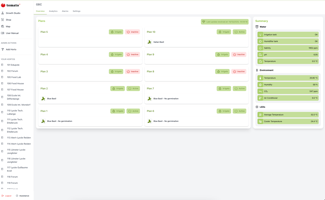
In more advanced systems (such as Tomato+'s Horto Professional models) cycles are adjusted automatically via artificial intelligence, using:
-
plant images
-
environmental data
-
growth rate
-
potential stress detection
This avoids waste and constantly optimizes irrigation based on the actual state of the plant.
4. Volumes: how much water you really need
The volume of water depends not only on the size of the reservoir, but mainly on:
-
drainage capacity of the substrate
-
plant consumption
-
temperature of the root zone
-
type of spraying
Technical guidelines
-
Lettuce, basil and baby leaf roots require small but steady flows.
-
Tomatoes, chilies and larger plants require more volume per cycle.
-
The basic principle: more plant biomass = more volume per cycle.
Pay attention to the root zone
If the volume is too high:
-
risk of "drowned" roots
-
less oxygen → slow growth
-
accumulation of salts → plant stress
If it is too low:
-
dry roots
-
faster EC changes
-
risk of continuous microstress
5. Automation changes everything
Irrigation is the area where technology brings the greatest benefits.
Systems such as Horto2, Horto4 and Horto Professional manage autonomous:
-
flows
-
cycles
-
volumes
-
water temperature
-
oxygenation
-
nutritional density
The user does not have to manually adjust anything:
Tomato+ greenhouses use sensors, telemetry and AI to create optimal conditions, 24 hours a day.
This ensures:
-
zero waste
-
consistent accuracy
-
repeatable results
-
faster and more stable growth
Conclusion
Flows, cycles and volumes are three parameters that work together to ensure healthy growth in hydroponics.
Knowing the principles is crucial for those who grow manually, while in Tomato+ systems these aspects are controlled automatically, allowing professional results without technical intervention.
Thank you for reading this article. Keep following us to discover new content on hydroponics, vertical farming, and smart agriculture.
Tomato+ Team