16. Nutrients in hydroponics: macro, micro and proper balances
In hydroponics, light is not enough. Water is not enough.
Real growth depends on an often underestimated element: nutrients.
Without a precise balance between macro-nutrients, micro-nutrients and solution stability, plants fail to reach their potential.
This applies to any system: from compact greenhouses to professional plants.
In this article we take a clear and practical look at how nutrients work in hydroponics and how Tomato+ manages them in its systems.
1. Macroelements: the structure of the plant
Macroelements are the nutrients that the plant needs in the greatest quantities.
They are the building blocks of growth, photosynthesis and final crop quality.
The main macroelements
-
Nitrogen (N) - leaf development and green color.
-
Phosphorus (P) - strong roots, energy metabolism.
-
Potassium (K) - water transport, texture and stress resistance.
-
Calcium (Ca) - strong cell structure.
-
Magnesium (Mg ) - basis of chlorophyll.
-
Sulfur (S) - protein and flavoring.
Common mistakes
-
Too much nitrogen → soft leaves and weak growth.
-
Too little calcium → burnt tips and necrosis.
-
Inadequate potassium → poor texture and poorer flavor.
2. Microelements: small dosages, huge effects
Microelements are needed in small amounts, but without them the plant stalls.
The main microelements
-
Iron (Fe) - essential for chlorophyll.
-
Manganese (Mn ) - activates photosynthetic processes.
-
Zinc (Zn ) - internodes and structural growth.
-
Copper (Cu) - enzyme functions.
-
Boron (B) - root and young tissue development.
-
Molybdenum (Mo) - nitrogen metabolism.
-
Chlorine (Cl) - osmotic balance.
Why are they critical?
Because they fluctuate easily:
an excess of iron or a deficiency of manganese can stunt growth even with correct EC and pH.
3. The real secret of hydroponics: balance
The point is not "how much" nutrient to give, but in what proportion.
Nutrient requirements change with:
-
the stage of growth,
-
the type of variety,
-
the water temperature,
-
the photoperiod,
-
the density of cultivation.
The correct balance depends on three factors
-
Plant stage
-
Germination: low N, more Ca and micro stable.
-
Growth: higher N.
-
Maturation: more K, less N for quality and consistency.
-
-
EC
EC indicates total amount of salts, not whether they are in the right proportion. -
pH
If the pH is wrong, the plant is not absorbing macros and micros properly.
4. How Tomato+ manages macro and micro in different models
Each Tomato+ model adopts different nutrient management, optimized for its level of automation.
Horto2 and Horto4: single nutrient bottle + safety EC sensor
Horto2 and Horto4 are designed to deliver professional results with maximum simplicity.
1. A unique nutrient bottle
The solution is:
-
granular,
-
pre-dosed,
-
balanced for the entire cycle (germination → harvest).
Just:
-
add demineralized water,
-
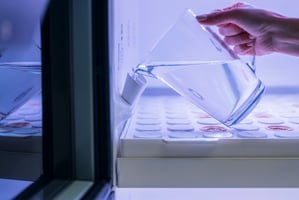
pour granular from the unique bottle.
No combination of vegetative or ripening stage: everything is already calibrated.
2. Integrated EC sensor (alert, not adjustment).
H2 and H4 do not automatically correct the nutrient solution.
They do, however, include an EC sensor that alerts when values are too far from optimal standards.
This happens when:
-
the granular has not been dosed correctly,
-
non-demineralized water was used,
-
the tank has not been washed properly.
The sensor does not intervene: it is an intelligent safety system.
3. Waffles have no nutrients
Waffles serve only as:
-
seed support,
-
moisture management,
-
absorbent structure.
All nutrients come from the unique bottle.
Horto Professional: automatic regulation of EC and pH + AI
Horto Professional is designed for advanced growers, R&D and professional production.
It integrates comprehensive sensors for:
-
EC,
-
pH,
-
water temperature,
-
environmental conditions,
-
AI chambers.
The software Tomato+:
-
measures parameters in real time,
-
automatically corrects EC and pH,
-
adapts nutrient profile according to growth stage,
-
continuously optimizes cycles through artificial intelligence.
(Source: Tomato+ technical materials )
Result: zero fluctuations, maximum quality, maximum yield.
5. How to recognize poor nutrient balance
Typical signs:
Deficiencies
-
Internerval chlorosis (Fe, Mg)
-
Slow growth (unbalanced micros)
-
Burnt tips (Ca or EC too high)
Excesses
-
Leaves too dark and soft (excess N)
-
Accumulation of salts in the substrate (high EC)
-
Bitter or inconsistent taste (too much K or micro)
6. Conclusion: nutrients are the basis of quality
In hydroponics, plants are totally dependent on the nutrient system.
Proper balance is what determines:
-
texture,
-
aroma,
-
speed of growth,
-
health of the plant,
-
final yield.
Horto2 and Horto4 make all this simple through unique nutrient solution and EC sensor.
Horto Professional guarantees absolute precision through EC/pH and AI automation.
The result is always the same: superior quality vegetables produced reliably and sustainably.
Thank you for reading this article. Keep following us to discover new content on hydroponics, vertical farming and smart agriculture.
Tomato+ Team