Hydroponics is not just an innovative method of growing without soil: it is a technology destined...
36. Integration of plant, software and cloud: the architecture that makes indoor agriculture truly smart
36. Integration of plant, software and cloud: the architecture that makes indoor agriculture truly smart
3:44
In advanced indoor farming, it is no longer the physical plant that makes the difference, but the deep integration between hardware, software and the cloud. Without this technological continuity, even the most advanced greenhouse remains an isolated machine, unable to improve over time.
In this article we explore how a truly integrated system works, what components make it scalable, and why end-to-end architecture is the real competitive advantage today.
Why integration is the real sticking point
Many indoor systems are born "siloed."
-
the system produces,
-
the software visualizes,
-
the cloud stores.
This approach does not generate intelligence, because it lacks the feedback loop.
An integrated system, on the other hand, creates a continuous loop:
measure → analyze → decide → correct → improve.
And it is this loop that transforms a greenhouse into a platform.
Level 1 - The plant: the source of data.
The plant is not just a growing environment, but a data acquisition system.
The main elements:
-
environmental sensors (temperature, humidity, EC, pH),
-
plant status sensors (flows, levels, consumption),
-
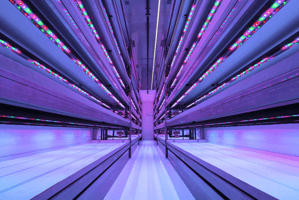
LED modules with multiple channels,
-
chambers for visual monitoring of growth.
Here the first transformation occurs: plant physiology becomes measurable data.
Level 2 - The software: where the data becomes a decision
The software is the operational brain of the system.
It not only displays information, but:
-
it interprets the data,
-
compares it to growth models,
-
governs actuators and parameters.
Key functions:
-
Growth Plans (static or dynamic),
-
automation of lights, irrigation and cycles,
-
remote and multi-plant management,
-
cultivation data historicization.
Without software, data remains noise. With software, it becomes control.
Level 3 - The cloud: where the system learns
The cloud enables what the local plant cannot do:
-
scale,
-
correlate millions of cycles,
-
train artificial intelligence models.
In the cloud happen:
-
data aggregation,
-
multi-variety historical analysis,
-
continuous updating of Growth Plans,
-
distribution of improvements to all greenhouses.
Each plant becomes a node in an intelligent network.
The feedback loop: the heart of the system
Real integration exists only if the loop is closed:
-
the plant measures,
-
the software sends to the cloud,
-
the AI analyzes and optimizes,
-
the cloud updates the parameters,
-
the plant makes corrections.
This is what distinguishes:
-
an automated system
from -
a self-improving system.
Scalability: why it matters more than the single plant
A non-integrated system:
-
works well only "there."
-
does not transfer knowledge,
-
does not improve globally.
An integrated system:
-
replicates patterns,
-
improves with each new installation,
-
reduces errors and variability.
It is why today the value is not in the hardware, but in the architecture that connects it.
The Tomato+ model: native integration, not addition
Tomato+ designed the system starting with integration, not adding it later.
-
system designed to collect data,
-
proprietary software with agronomic logic,
-
scalable cloud for AI and continuous improvement.
The result is a platform in which plant, software and cloud are not three elements, but one coherent system.
Conclusion
In modern indoor farming:
-
the plant cultivates,
-
the software governs,
-
the cloud evolves.
Only when these three levels are integrated is a system born that is capable of:
-
produce better,
-
learn faster,
-
scale without losing control.
And it is this integration that defines the future of indoor agriculture.
Thank you for reading this article. Keep following us to discover new content on hydroponics, vertical farming, and smart agriculture.
Tomato+ Team