26. How to predict yield, cycles and harvest times in vertical farming
Predicting in advance how much yield you will get, how long a cycle will last, and when you will harvest is one of the most complex-and strategic-elements of vertical farming.
Indoor growing allows a level of control impossible in traditional agriculture, but it does not eliminate the need to accurately predict crop performance.
In this article we look at:
-
What yield and harvest times depend on
-
How to build a reliable forecast
-
The minimum data to monitor
-
The variables that distort forecasts
-
How automation and AI (such as that in Tomato+ greenhouses) completely change the process
-
Practical approach to estimating yield and cycles in an indoor facility
1. What yield and harvest times depend on
Yields in vertical farming do not depend on the "green thumb," but on a precise set of parameters:
-
Photoperiod (hours of light per day)
-
Light intensity (PPFD) and LED spectrum
-
Available nutrients and their balance
-
Air and water temperature
-
Relative humidity and VPD
-
Planting density
-
Genetics and variety
These parameters define the metabolic rate and, consequently, the expected growth time.
2. How to build a yield forecast
A realistic forecast does not start from intuition, but from a model consisting of three elements:
A. Historical data
Each previous cycle provides:
-
growth curve,
-
fresh weight per plant,
-
waste,
-
germination and ripening times.
The more data you have, the more reliable the prediction becomes.
B. Environmental parameters
Stable prediction is only possible if environment and lighting are repeatable and controlled.
Otherwise, historical data become unusable.
C. Mathematical model or AI
One can start from a simple linear model:
"Given the same PPFD and temperature, variety X reaches biomass Y in Z days."
Or use advanced models such as those built into the Tomato+ system, which cross-reference:
-
thousands of data points per cycle,
-
plant images,
-
actual growing conditions, to return an optimized and updated cycle in real time.
3. The minimum data to monitor for reliable forecasts
To achieve forecasts with <10% error, at least these data per cycle are needed:
-
Final weight per variety
-
Actual growth time (germination → harvest)
-
Average PPFD by level
-
Nutrient consumption and EC/pH deviations
-
Water temperature (critical in hydroponics)
-
Daily VPD
-
Rejection rate and anomalies
In Tomato+ these data are automatically collected from sensors and telemetry, and stored in the AWS cloud to feed AI.
4. Variables that distort predictions
Even in a controlled plant there are factors that can compromise accuracy:
-
uneven PPFD between levels
-
root stress from incorrect water temperature
-
sudden changes in EC/pH
-
errors in seeding or density
-
non-uniform microclimate (insufficient airflow)
-
suboptimal light spectrum for that growth stage
Predictions only work if the environment is stable.
5. How automation and AI change yield forecasting
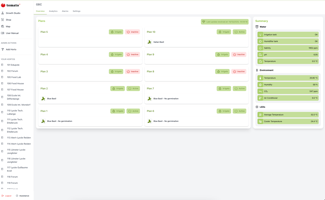
Tomato+ technologies make it possible to overcome the "human" logic of forecasting with a much more robust model:
A. Continuous data collection
Each greenhouse sends data on:
-
light received,
-
humidity,
-
temperature,
-
plant status via AI imaging.
B. Dynamic Growth Plan
AI automatically modifies:
-
LED intensity,
-
photoperiod,
-
nutrients,
-
climate parameters to keep the plant on optimal growth curves.
C. Forecasts that improve over time.
Each new Tomato+ installation adds data to the network and improves forecast accuracy for everyone.
It is a network effect applied to agriculture: more greenhouses → more data → more accurate models.
6. How to estimate yield and cycles in practice (operational framework)
Step 1 - Define the targets
-
Expected weight per plant
-
Cycle days
-
PPFD and photoperiod
-
Water and air temperature
Step 2 - Set the environment in a stable manner.
If environment and light fluctuate, forecasting is useless.
Step 3 - Use varieties and densities that have already been tested.
Each variety has a characteristic curve.
Step 4 - Compare the current cycle with the model
Check weekly:
-
predicted vs. actual biomass
-
growth delays
-
any stresses
Step 5 - Update the model or let the AI do it.
In the Tomato+ system, the Growth Plan updates itself by correcting any delays.
Conclusion
Predicting yield and cycles in vertical farming is not a theoretical exercise:
it is a technical process based on data, environmental control and predictive models.
The future (already a reality for Tomato+) is no longer "estimating," but calculating in real time:
-
how much the plant will grow,
-
when it will be ready,
-
what yield will be obtained,
-
and how to optimize the next cycle.
Truly industrial production arises only when yield is no longer a surprise, but a guaranteed value.
Thank you for reading this article. Keep following us to discover new content on hydroponics, vertical farming, and smart agriculture.
Tomato+ Team